

We are all wealthy beyond our ancestors’ wildest dreams, and we have forgotten it.
Many ordinary parts of your daily life, entirely unremarkable, not prized or treasured but treated as an expected standard notable only if absent, were once precious rarities, available in such a quality only to an elevated few or perhaps nonexistent entirely.
I once lived and worked for three months in a part of the world where the vast majority of the people around me had no shoes.
Not “bad-quality shoes” or “old hand-me-down shoes” or “shoes with holes in them that they couldn’t afford to repair,” but no shoes. Most people in the rural Kianjavato district of Madagascar when I was living and working there for three months in 2019 owned absolutely no shoes at all, and walked barefoot everywhere for all occasions of their life. I walked on the trail of endangered lemurs up hillside paths covered in slick red mud, laced with tree roots, and studded with stones, and thought myself a bold adventurer until I recalled that I was wearing precision-engineered hiking boots and the Malagasy people walking beside me — generally ahead of me — were barefoot1.
Now, I quite like being barefoot sometimes. At home, or at the beach, or in a grassy field. But the thing is, when I’m barefoot, it’s a choice. These people had no choice. Really think for a second about what it means to not have the option to wear shoes ever, at all.
Did I mention that malaria and schistosomiasis were endemic? That this particular region of Madagascar was, in fact, known to be among the worst places in the world in terms of risk of exposure to water-borne skin-burrowing parasites? It was. The research station where I lived had water filters, and I was taking atovaquone-proguanil malaria prophylaxis pills, and I had waterproof hiking boots to wade through streamlets that crossed the path and a strict warning to never, ever let my nude skin touch wild water. The average local person had none of that. Bare feet, open to mosquitoes and nasty flesh-tunneling disease-spreading worms, splashing through water and mud every working day in a hard-working life. Ye gods, the major staple crop there was rice, and this was a subsistence agriculture economy, which meant that a substantial chunk of the people of Kianjavato spent all day barefoot up to their shins in a rice paddy flooded with parasite-ridden local water!
Some of the more well-off people in the village had flip-flops. They all seemed to be more or less the same brand and quality of flip-flops, and they were the cheapest, crappiest flip-flops I’d ever seen, mass-produced probably years ago in China and gradually diffused down to itinerant merchants in rural Madagascar, made of thin gray plastic that practically flaked as soon as you looked at it. The little toe-thong thing holding the flip-flop on the foot was about as sturdy as a rubber band. On many of these flip-flops, it had just broken and had been crudely mended or replaced by a homemade strap of bamboo or vine.
We weren’t allowed to give them our shoes. Or any shoes. There was actually a specific written policy about this at the NGO I was volunteering with, part of the contract/handbook we’d all agreed to before the journey. We, the volunteers from first-world countries, were expressly forbidden from giving away any of our extra pairs of shoes, be it sneakers or hiking boots or even a better quality of flip-flop for wearing around camp, even to someone we’d worked alongside for months and really wanted to help out, because experience had taught them that it caused severe resentment, jealousy, and ill-feeling in the local community. Akin, perhaps, to someone on a job site being casually given a Lamborghini by a passing billionaire, and suddenly being vaulted into a much higher stratum of material good than his fellow workers through no merit of his own. It would be hard not to resent something like that.
Several Malagasy folks working at the research station did indeed ask me to leave them my boots when I was departing, and I duly told them that it was not allowed.
It’s been a formative memory. Sometimes, in the years since, I’ve looked at homeless people or panhandlers in developed countries and I’ve thought something like, At least you’ve got shoes. What you’re wearing right now would mark you as a very rich man in Kianjavato, Madagascar. It’s perhaps an unkind thought, but a recurring one.

I was in Delhi, India, for ten days in late May and early June 2024, during a record-breaking heatwave and a national election. The brief period when I was there in that ancient megacity contained, in fact, both the largest election in the history of the world and the hottest day in the recorded history of Delhi up to that point.
It was so hot that pointing your face at the sky hurt like you’d shoved it into an open oven door. It was so hot that the frames of my glasses burned against the skin of my face. It was so hot that spilled hand sanitizer stung like spilled hot chocolate. It was so hot that my phone displayed a “System overheating” warning if I spent too long out of the shade. It was so hot that I saw a man collapse in the street from heat exhaustion, and gave him my second backup water bottle.
I could buy cold and comfort whenever I wanted. The exchange rate was over ninety rupees to the dollar when I was there, and a lot of stuff didn’t cost very many rupees. I slept in air-conditioned Airbnb rooms. I wrote, some of the time, in cafes where you felt a wall of cold air blasting you as soon as you stepped in the door. I bought cold water bottles and drank them down more or less constantly throughout the day.
But I also explored the super-heated city, sweat pouring down my skin and leaving salty ridges on my clothes. And in one corner of Delhi, near the Laxmi Nagar metro station, I went into a little shop selling parathas, a flaky flatbread similar to yet distinct from the better-known naan. I had some aloo parathas, with a delicious lightly spiced potato filling. And I felt, shockingly, almost comfortable while eating in that shop, despite the heat of the oven itself and the wide-open door to the heatwave outside, because it had a little fan.
Just one small, very elderly-looking, wire-framed black fan, sitting on a counter as I recall, that did little more than gently prod the air to move. Probably needed just a trickle of electricity, a few little watts. But it made such a difference. People flocked to that paratha shop, a little oasis of relative cool. Its shady depths, lightly stirred by the fan, gave a moment of sheltered relief to the old and young. The shade would still have made it a place of refuge in a pre-electricity world (though a pre-electricity world probably wouldn’t have had a heatwave like this) but the fan made it so much better.

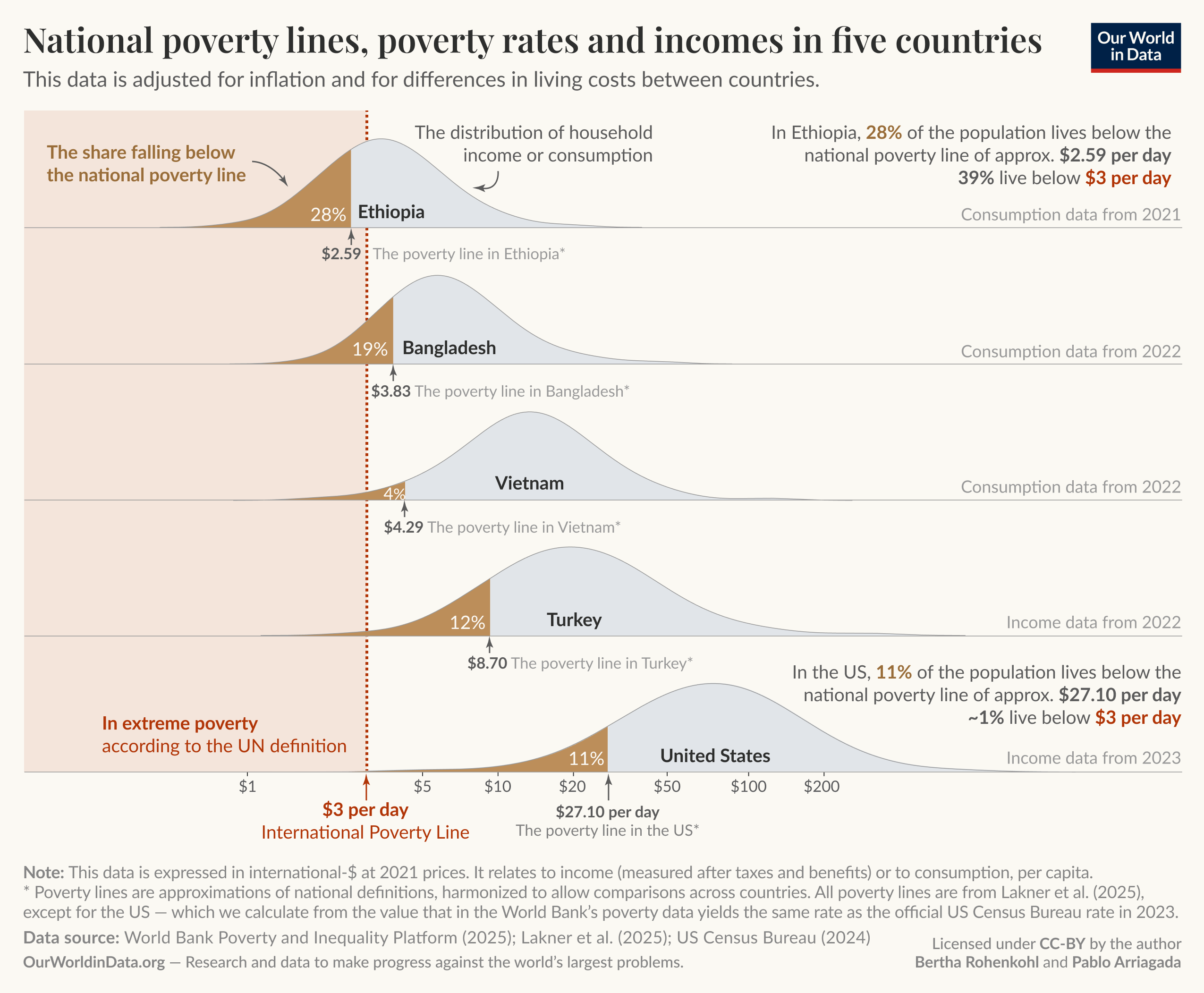
Extreme poverty is not the same as what we in developed countries think of as poverty. The difference between affluence, developed-world poverty, and extreme poverty is the difference between having good new shoes, bad old shoes, and no shoes at all, ever. It’s the difference between comfortable air conditioning, just a fan, and no protection from the heat at all. It’s the difference between a good meal, a bad meal, and starving.
Extreme poverty has a formal definition, and it is different from national poverty lines that vary by country. In the United States in the 2020s, 11% of people live below the national poverty line, set at about $27.10 per day in 2021 prices, but less than 1% of people live at the UN International Poverty Line, set at $3 per day. In Ethiopia, a full 39% of people live below $3 per day. This is what headlines like “China lifted 800 million people out of extreme poverty in the last few decades” mean — not that those people may not feel poor and struggling, but that they are unlikely to have zero mass-manufactured material possessions and be at risk of literally starving to death.
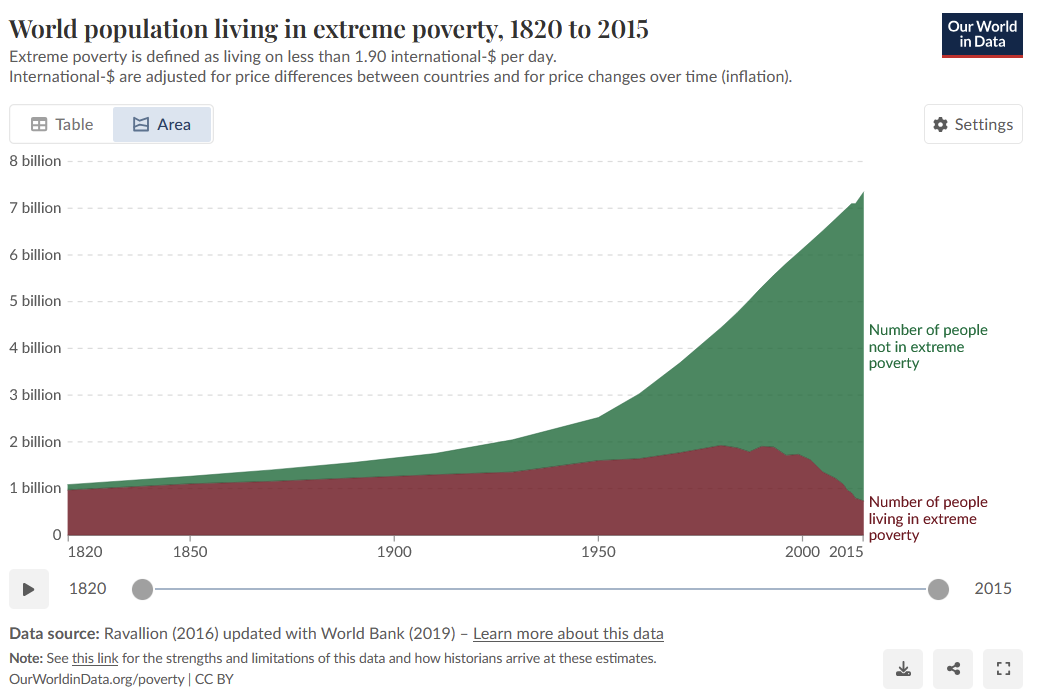
And extreme poverty has decreased. Immensely. Massively. Unprecedentedly. World-changing-ly. In both relative and absolute terms. The epochal decrease in extreme poverty is the defining aspect of human existence on Earth today, and it is still deeply, deeply, under-discussed and little-understood.
In 1910, just 116 years ago, there were about 1.75 billion human beings alive on Earth. According to our best available data, in 1910 1.30 billion people were living in inflation-adjusted extreme poverty. The majority of humanity was subsistence farmers on the edge of starvation, spread across Asia, Africa, Europe, and the Americas. This was not post-apocalyptic (quite the reverse), this was much like the way things had been for millennia.
In 2015, there were about 7.35 billion human beings alive on Earth. The global population had more than quadrupled, a never-before-seen growth rate called “more bacterial than primate.” Yet, almost unbelievably, extreme poverty was lower. Despite a century full of World Wars, genocides, and oppression, the flowering and fruits of the great enterprise of science had produced a surge of progress unparalleled in human history. We had not fallen into a Malthusian nightmare, we had produced world-historically widespread prosperity. According to our best available data, in 2015 around 734 million (0.734 billion) people were living in inflation-adjusted extreme poverty.
The ever-excellent Oxford project Our World in Data has a great in-depth article on this, including the in-depth research behind how they they got the numbers and adjusted for inflation.
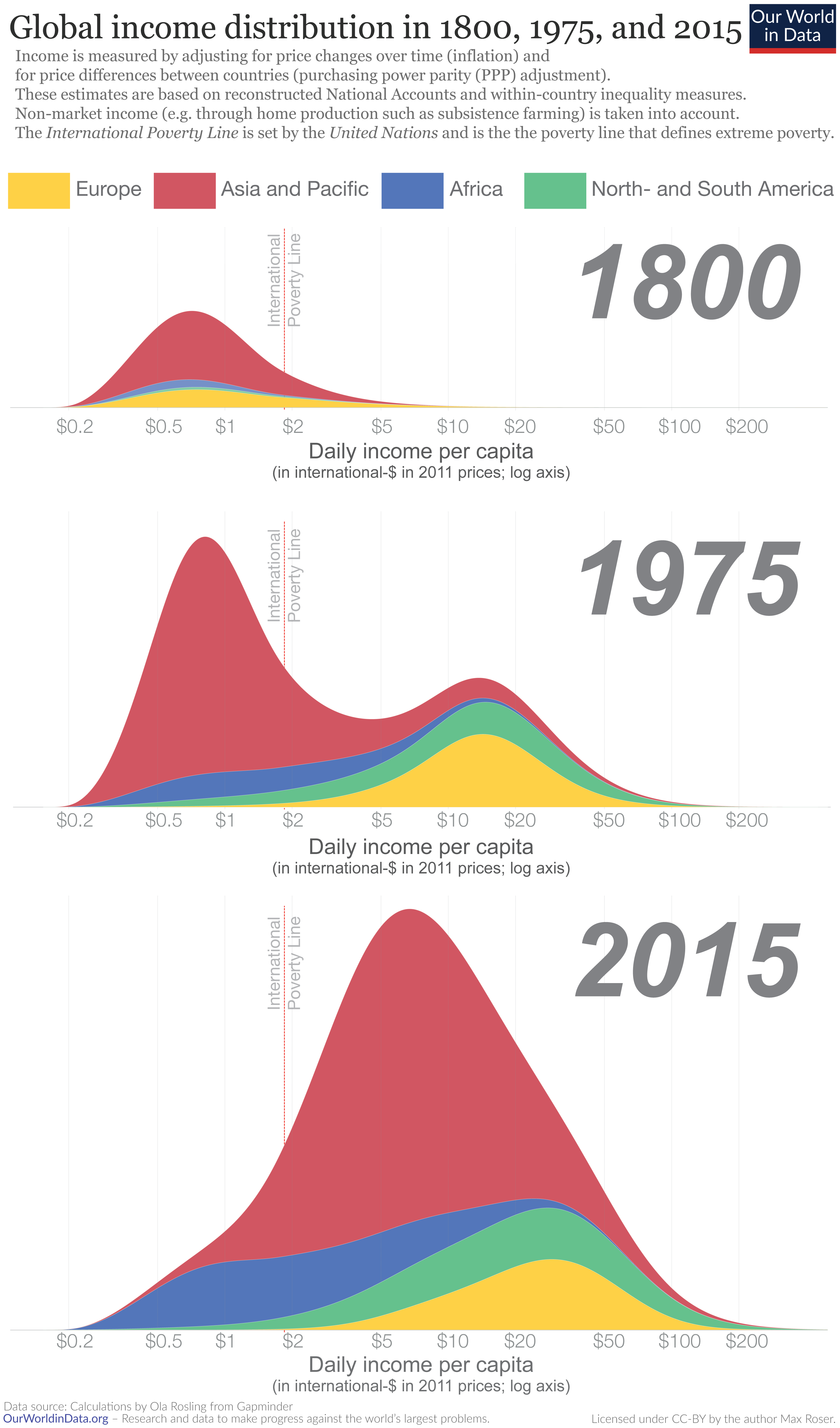
Billions of people, the great growing majority of humanity, have been uplifted and uplifted themselves from a hand-to-mouth existence over the last hundred and fifty years, a mere blink of the eye of the great expanse of time since the emergence of anatomically modern humans around 200,000 years ago. We live in a golden age, richer than any ancient empire that ever was.
And it is simultaneously true that lately in many countries a growing fraction of wealth has accrued to the tiny group of people on the far right of the graph above, the centimillionaires and billionaires and now, sigh, the evil mass-murdering trillionaire. (Also note that this chart is plotted on a logarithmic axis). Inequality is a big-deal serious issue, and none of this article about the rising tide of human wealth should be taken as waving that away. I personally think that substantially more redistribution would help us progress even faster.
But it is also true that there is now so very much forgotten wealth. What would be manna from heaven to a villager in Kianjavato today or a Swedish peasant during the 1600s famines is now the bare minimum ordinary everyday expectation for billions of people. That’s real progress worth acknowledging, celebrating, and building upon.
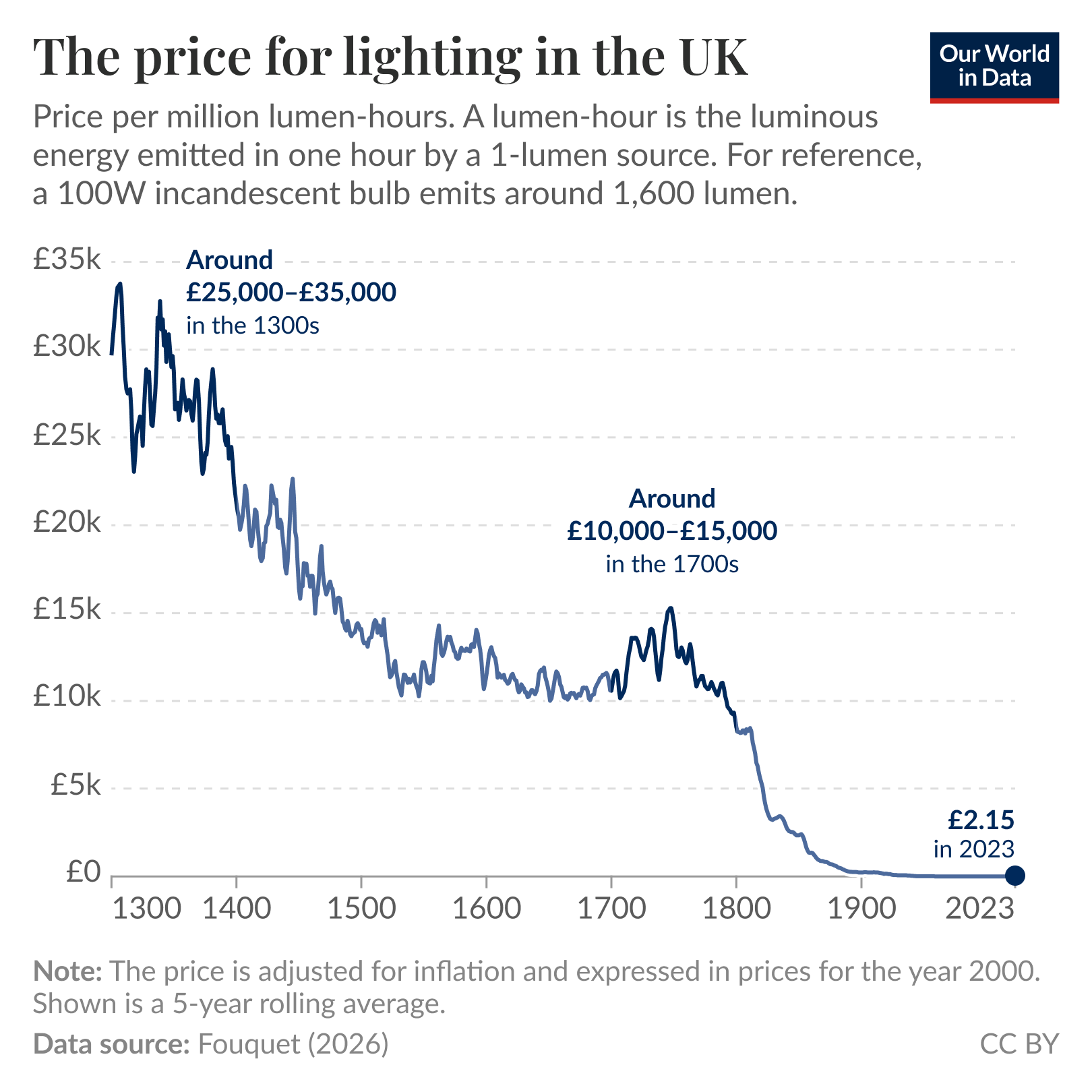
Right now, you, the person reading this, are by some very reasonable definitions an immensely wealthy person, beyond your distant ancestors’ wildest dreams. I know that is true by definition because you are READING this, which means that you are literate and you have at least some form of access to a device with a screen. You may be working a soul-crushing dead-end job or deep in debt or wracked with pain in a dire health emergency — I’m not trying to downplay these real and important struggles — but if you are reading this, you also have access to over 75,000 free books, more than the greatest kings and emperors of centuries past2 could ever have hoped for. You almost certainly are not starving to death for lack of food — you may be food insecure, but you are not “surviving on a handful of grain a day and then going to buy more and finding there’s no more for sale” food insecure, which was a precarious yet common state of being for much of humanity for thousands of years. You have unlimited light at night for almost nothing — the price of lighting has dropped by 99.9% in the UK since 1700, when it would take hours of work to earn the price of enough guttering candles to equal a few cents’ worth of modern lightbulb time.
There are so many more instances of this forgotten wealth in daily life. Just recently, there were several historic heat waves in France. I returned from East Africa right as it was starting, after a month-long trip where I had crisscrossed the Equator, and found temperatures higher than anything I’d encountered during my journey upon my return to northern Europe. My wife and I sweltered in our fifth-floor apartment, which had no air conditioner nor even a ceiling fan. We bought a standup fan — we named it Boreas, after the Greek god of cold winds from the north — and moved it between rooms to ease the heat wherever we stayed for more than a minute. We adapted behaviorally; we went out more in the evening, shuffled carafes of tap water in and out of the refrigerator throughout the day, and made cold-brew instant coffee before each bedtime and put it in the fridge overnight for the next morning. The fan and the fridge really really helped. We had more-or-less normal days despite the unprecedented heat.
Also, relatedly, for quite a few months after we moved in together, we were washing dishes by hand in a sink, with dish soap and a washable microfiber cloth. This got a bit tedious, and eventually I realized I was planning meals that I wanted to cook almost entirely around dishes-minimization, ideally with just one pot or saucepan. My wife did some ingenious DIY home plumbing work that I still don’t quite 100% understand that allowed our apartment to have enough water hookups for both a dishwasher and our existing laundry-washing machine. (The washing machine now drains into the bathtub). And that allowed us to make a change. When we finally got a dishwasher — it was, I think, March 2026 — it multiplied my enthusiasm for cooking at least tenfold, and it feels ridiculously luxurious to just load it and have clean dishes a few hours later. I have at least a faint glimmering of an idea how a 1950s housewife must have felt when consumer appliances for the home first became widespread at an affordable price. They really are a handy-dandy piece of practical magic, a brownie or Nis or house-elf to make everyday life just that little bit less full of drudgery.
Even freaking smartphones have become commonplace! They’re new enough that people still remark on it, it’s not exactly forgotten wealth, but still — a Library of Alexandria in the palm of your hand, a Lens of 21st-century Civilization, a scrying mirror in which to see all the glorious paladins of good and warped goblins of weirdness and gibbering demons of evil the Internet has to offer, a personal terminal to the schizophrenic global hive mind. Certainly not 100% good, but definitely an extraordinary thing for most of humanity to now have in the literal palm of their hand.
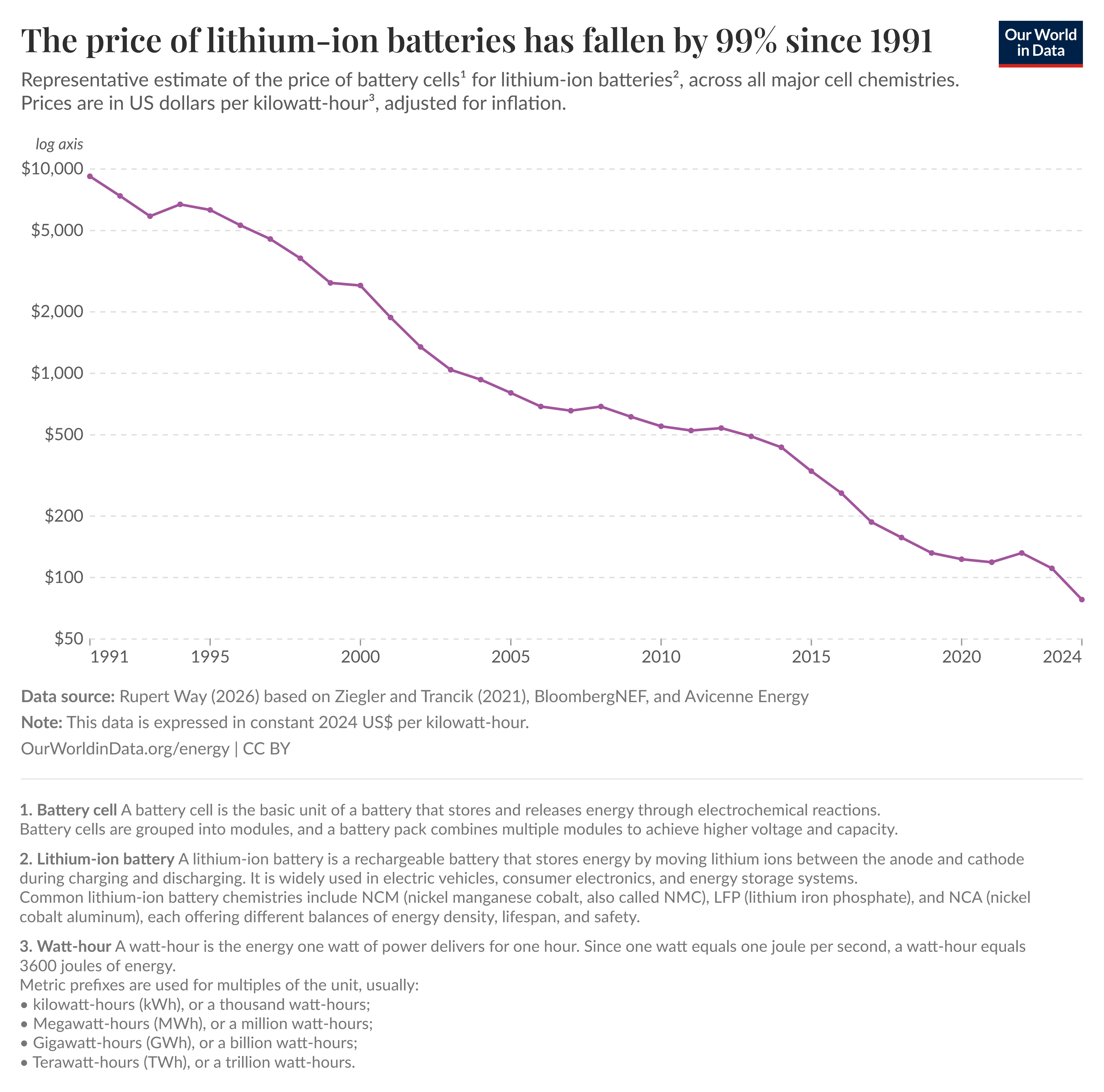
Solar panels and home batteries could become “forgotten wealth” like that. Very, very soon. In some households in early-adopter countries like Germany and Australia, they probably already are. Lithium-ion battery prices have declined by 99% already just since 1991, and we’re just scraping the surface of the incredible energy storage possibilities available. Not that far in the future, people around the world will be saying something like “Yeah, of course I have devices that generate and store enough free electricity to power my daily life, who doesn’t? I got a kit for 99.99 at the big-box store on the corner a few years back.”
On a more abstract note, access to healthy ecosystems and resurgent wildlife populations could become “forgotten wealth” like that too. In many places it already is, in a way, as a product of all our other forgotten wealth allowing us to care about animals for the sheer pleasure of witnessing their existence without having to see them as desperately needed resources for survival. In my parents’ New England home, deer and ducks and squirrels frolic in the garden with relatively little fear of humans. They wouldn’t have done that this town in 1910, when deer were over-hunted across America to the point of extinction fears, nor in a 1700s colonial farmstead or even a 1300s Native American camp, where there would have been fewer people but even more need to hunt them for food. In Paris, France, you can swim and see swans and read about rare mussels in the River Seine today, because of all the forgotten wealth that made the city rich enough to spend resources on building better sewage and water purification systems.
Many cultures have myths of a lost time of poverty-less abundance and peace between humans and animals, a Garden of Eden or Krita Yuga or Hesiod’s Golden Age. That may well lie not in the past but in the future, if we choose it. We are all much richer than we realize. We have traveled far on the halting, stumbling road to utopia, and I believe that humanity can and will fight and strive and innovate to progress further still, to heights yet undreamt of.
It’s like that old line about the 1900s dancers, how Ginger Rogers did everything Fred Astaire did but backwards and in heels.
Ashurbanipal, a brutal Assyrian emperor with the title “King of the Universe,” is credited with founding the first library at Nineveh — and it had only about 30,000 clay tablets, and many of those were the Iron Age equivalent of Excel spreadsheets. Thomas Jefferson, a rich man with a renowned passion for book collecting, owned about 6,700 books at a high point and just 1,600 when he died. You, right now, have access to over 75,000 free books.
Wow. What a wonderful "appreciation". Just WOW.
Thanks for the perspective.
I'm having a much better day!
Great essay and perspective, Sam, and well written, too, all toward the result of the pleasure of reading it. Thanks. The myth of zero-sum and therefore the desire to hoard one's wealth. Humans can create more wealth, and share more of this wealth, as your post compellingly illustrates.