

The Big Picture: Africa’s Quiet Solar Revolution!
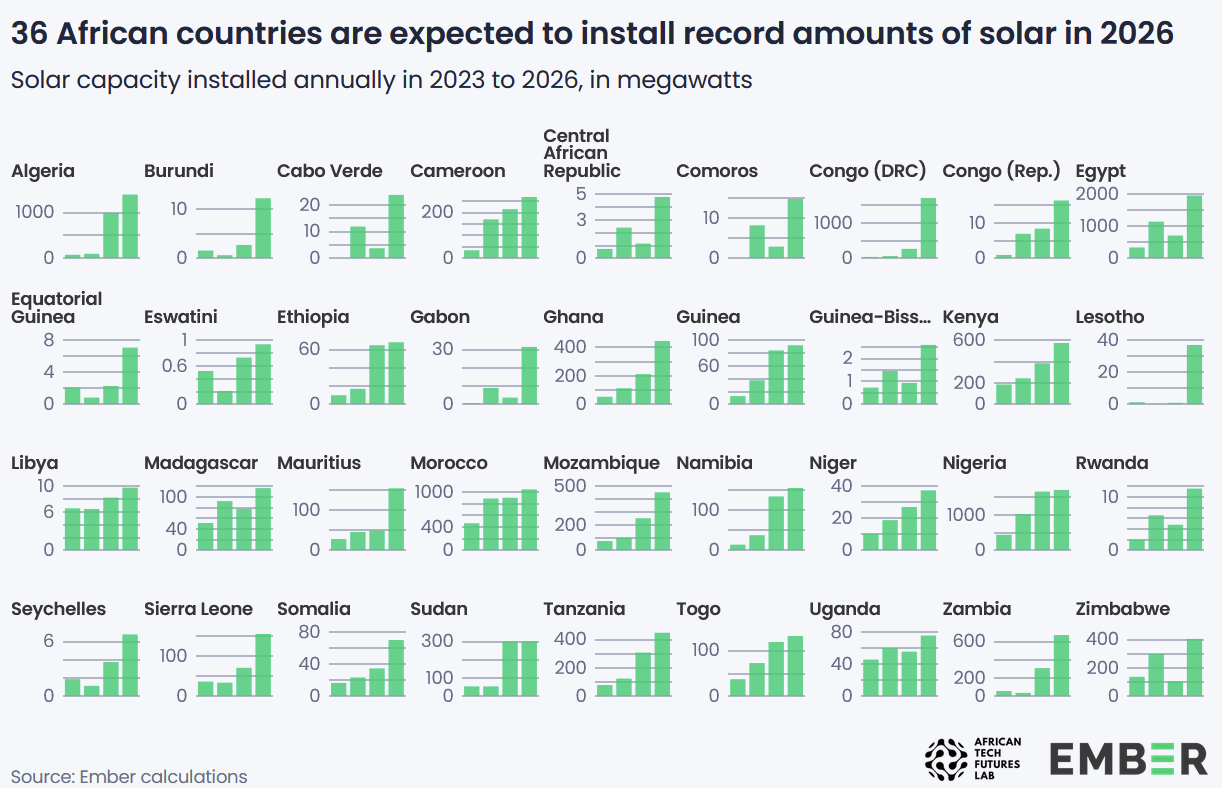
Indispensable think tank Ember has an electrifying new update on the emerging quiet revolution of decentralized solar power deployment across Africa! A full 36 African countries (out of just 54 on the continent!) are on track to install record-high amounts of solar in 2026! 19 of these countries have seen year-on-year solar installation growth of over 100%, including 544% in the DRC, 282% in Zimbabwe, and 176% in Egypt. In 10 of these countries, collectively home to 190 million people, new solar in 2026 amounts more than 10% of their entire grid capacity! Senegal is on track to add a full 80% of its 2023-era grid capacity in new solar additions from 2023 through 2026!
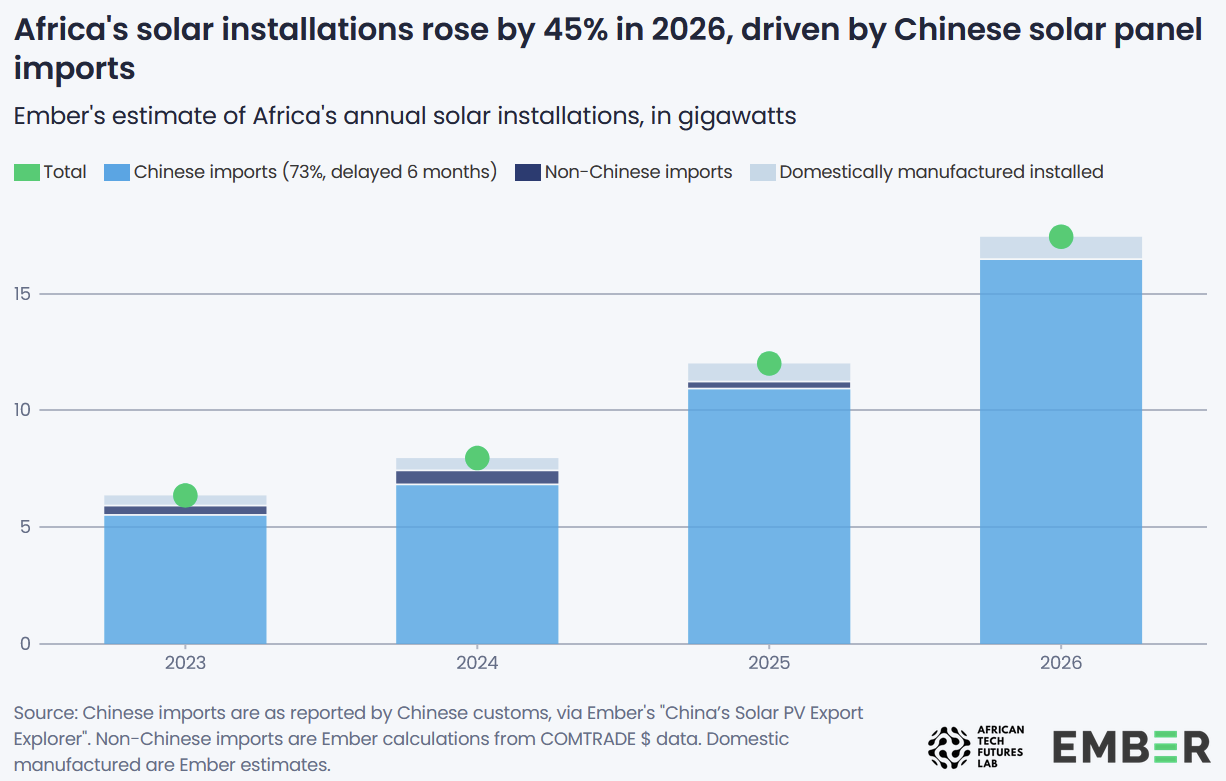
Total African solar installations are on track hit 17 gigawatts (17,000 MW) in 2026, the third consecutive record-high year and 45% above 2025 numbers. Approximately 100,000 solar panels are being installed in Africa every day in 2026! Solar may now be on track to meet all electricity demand growth in Africa in 2026. Battery imports are also skyrocketing (overtaking solar imports by value in some countries, like Nigeria!), forming a revolutionary duo that replaces costly, polluting diesel generators.
“The rise in solar capacity is likely to meet much of Africa’s electricity demand growth, and the sheer scale of cheap new supply could spur more demand growth too, creating huge human benefits…
A year of Chinese panel imports cost $2.4 billion USD; generating the same electricity from diesel would cost around that every three months.”
— “The take-off in African solar that official statistics can’t yet see.”
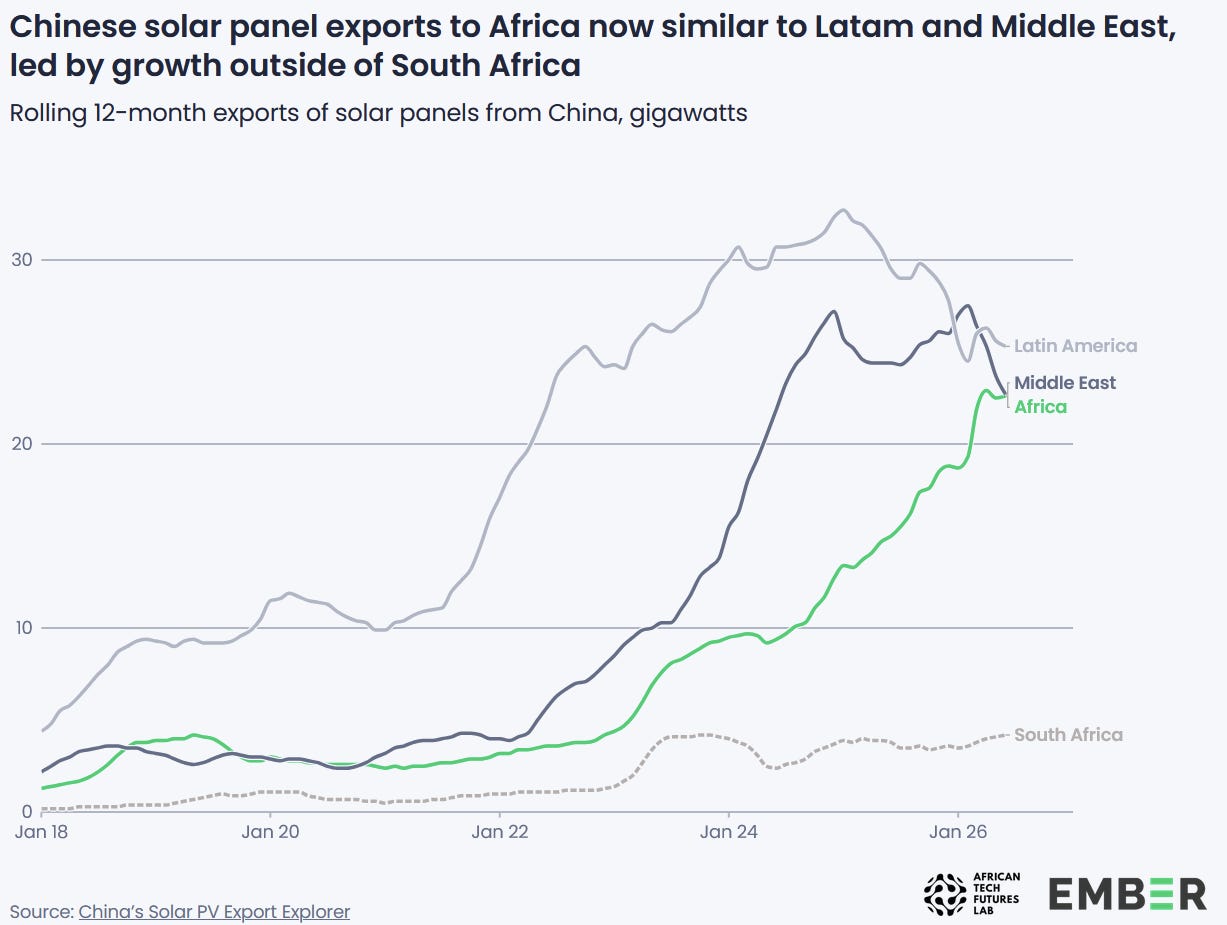
An estimated 94% of all these solar panels are coming from China, with the small but growing domestic African solar manufacturing sector, led by Egypt and Tanzania and primarily focused on exporting out of Africa, accounting for most of the remaining 6%.
Ember is calculating all this primarily from import-export data (mostly Chinese), not the African countries’ own records, as most of what’s being built (up to 75% of African solar build-out) is small-scale distributed solar which tends to not show up in official statistics. Only 12 African countries report on distributed solar at all! On-the-ground evidence, like a massive surge in new solar installation company licensing, concurs.
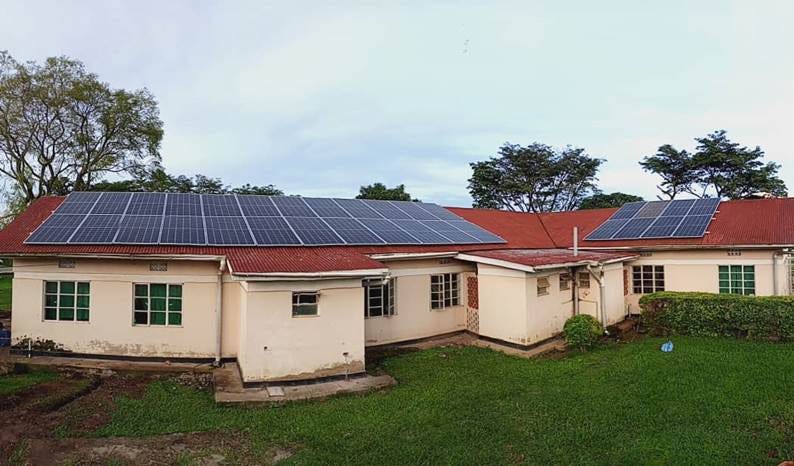
This is the best news I’ve seen all year, and reporting on good news is my job. I’ve been reporting on the revolutionary potential of electrotech for African development for a long time, and got to visit some leaders in-person in Uganda and Rwanda recently. It’s really happening! The solar revolution uplifting Africa is under way!

This isn’t just an avoiding-emissions story, though that is big and important, but a climate-resilience story, a healthcare-access story, an economic-growth story. It’s a whole new solarpunk model of human development. Africa is, at long last, beginning to truly rise — with the power of the Sun.
Costa Rica
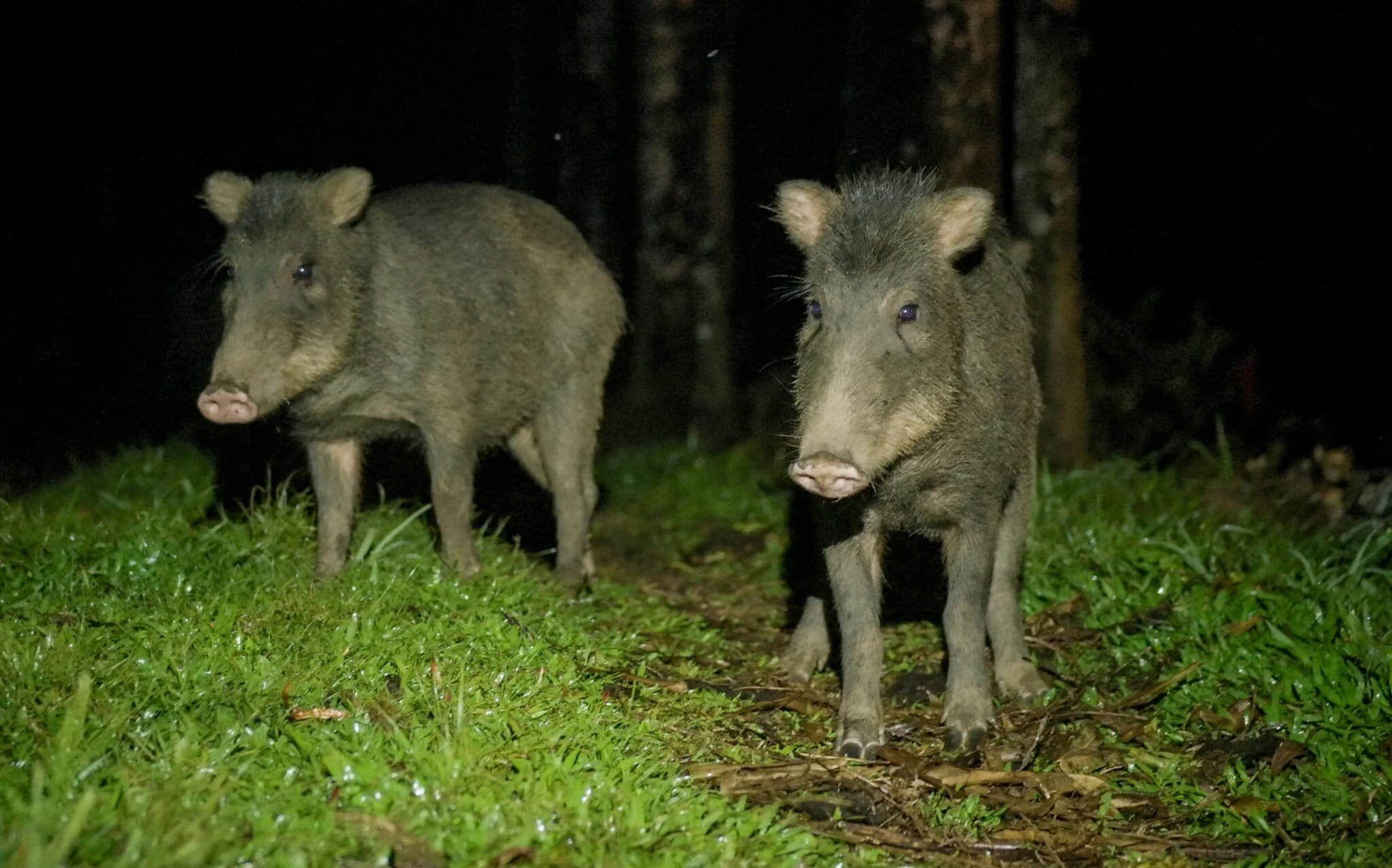
A herd of 13 white-lipped peccaries (Tayassu pecari) have been reintroduced to Piedras Blancas National Park in Costa Rica with a 16-hour, 20-person truck and boat relay voyage crossing the Golfo Dulce from the peccaries’ wild-capture site in the Osa Peninsula. The wild pig relatives had been wiped out from Piedras Blancas by hunters about 18 years ago, and serve a vital ecosystem engineer role by aerating the soil, creating wallow pools, and spreading seeds. Excellent rewilding work!
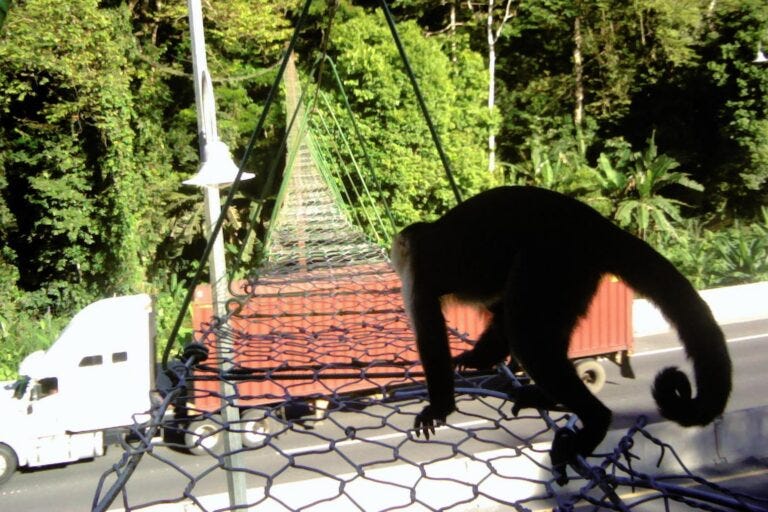
In August 2026, the lawmakers of Costa Rica unanimously voted for a new measure mandating wildlife crossings for any new or existing road infrastructure that has been proven to threaten ecosystem connectivity or wildlife safety. At least 59 species have already been documented using Costa Rica’s existing wildlife crossings (often low-cost canopy-to-canopy rope bridges) with monkeys, sloths, opossums, and kinkajous the most common travelers. This Central American ecotourism hotspot is institutionalizing a fast-spreading, highly effective human/wildlife coexistence tool!
Netherlands
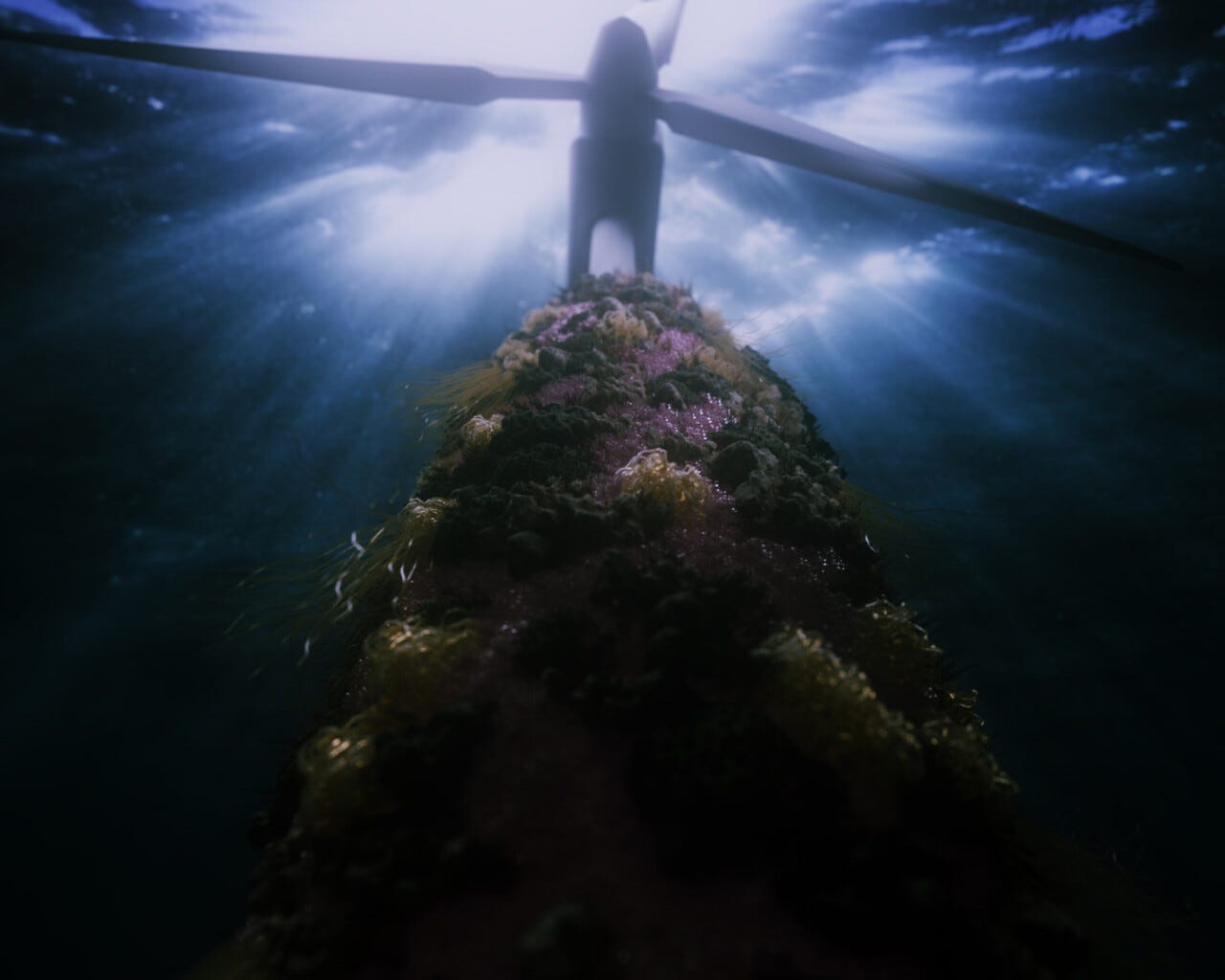
Offshore wind farms are proving to be biodiversity-boosting artificial reefs around the globe, and those in the waters of the Netherlands are among the most well-studied and proactively conservation-managed. The 139-turbine Hollandse Kust Zuid project now occasionally shuts down during key bird migration windows, and their turbines’ extra-large water-filled hollow interiors are now regularly visited by fish and seals! Seals hunting fish, inside clean power-generating wind turbines. Awesome news!
China
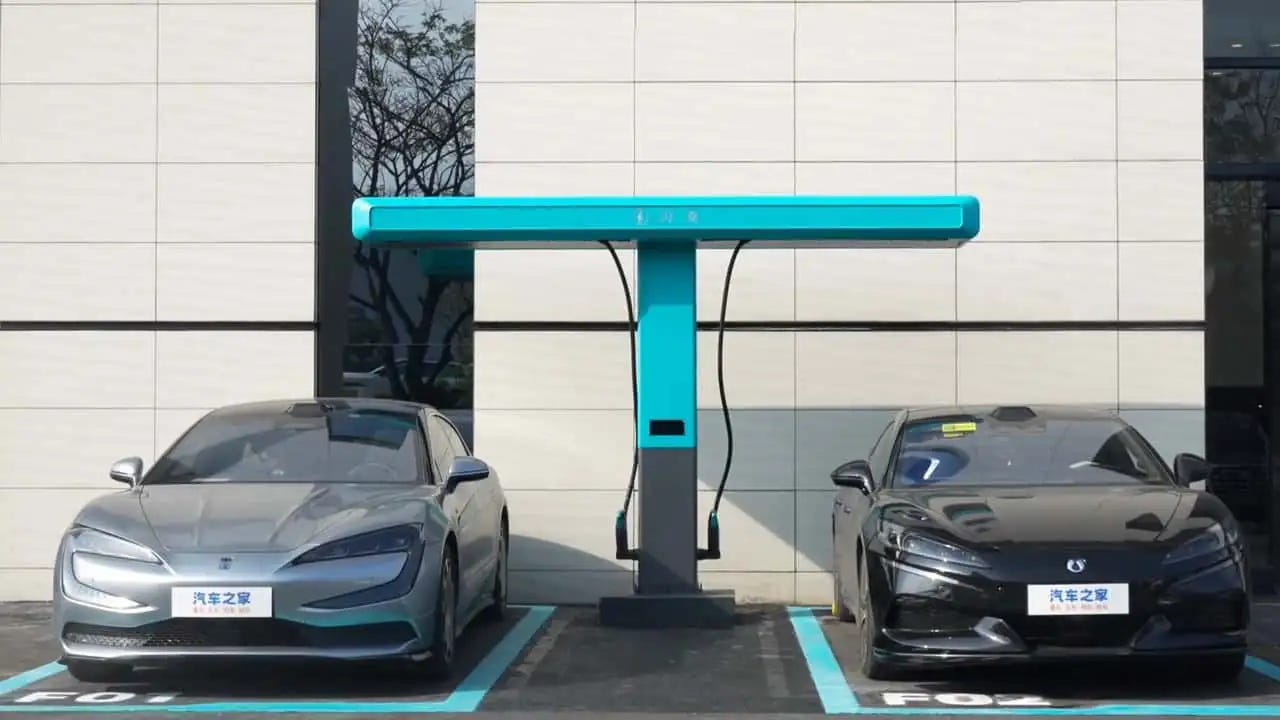
As of August 2026, BYD has deployed over 10,000 of its new cutting-edge Flash Chargers across 300 cities in China. A BYD Flash Charger can send 1.5 megawatts of power through a single cable and charge a BYD Blade 2.0 battery from 10% to 90% in just nine minutes. All Flash Chargers so far have been built since the beginning of 2026, and BYD plans to double the network again to reach 20,000 before 2027. Wow!
The Chinese government reports that air quality continues to improve across China, with average aerial concentration of lung-harming particulate matter declining by 6.2% from the first seven months of 2025 to the first seven months of 2026.
New Zealand

2026 has been an excellent mating season for the critically endangered kākāpō (Strigops habroptilus), the world’s heaviest parrot, thanks to a bumper crop of nutrient-rich rimu tree berries. All wild kākāpō now live on predator-free refuge islands, with every one wearing a transmitter pack, and the population has risen from 51 to 235 in the last three decades. Now, on September 1 2026, the ninety surviving chicks from the 2026 season were officially added to the population census, bringing the total number of living kākāpō in the world to 325! That’s the first time the kākāpō population has exceeded 300 birds in an estimated 75 years. SPECTACULAR news!
Indonesia
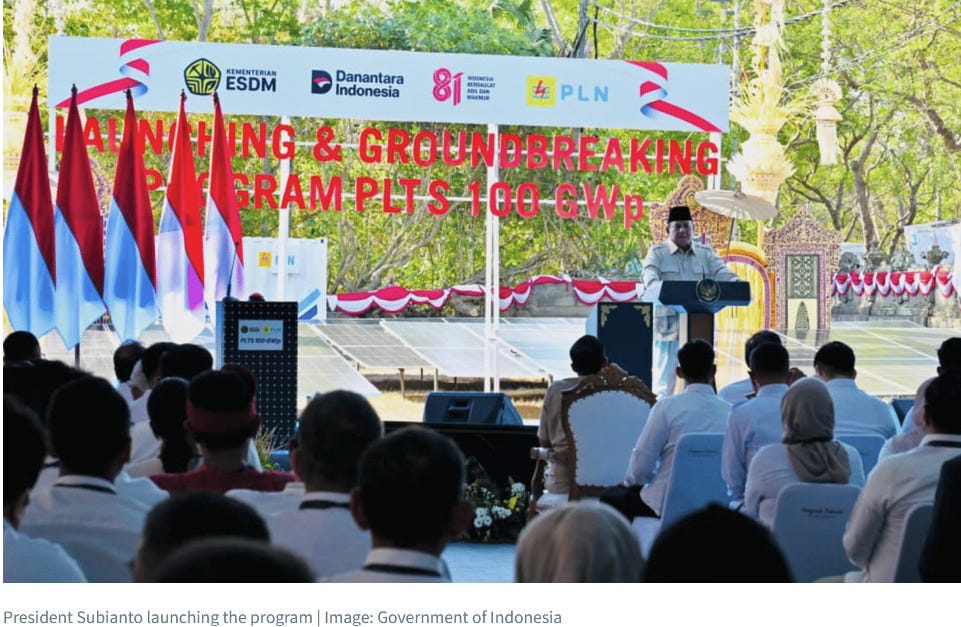
On August 25, 2026, President Prabowo Subianto of Indonesia held a launch event for the vast 288 million-person archipelago nation’s gratifyingly ambitious plan to build 100 gigawatts (100,000 MW) of new solar power capacity by the end of 2029. For context, Indonesia had only 1.49 gigawatts of solar nationwide at the end of 2025, so this would be an unprecedentedly fast world-leading scale-up of clean energy!
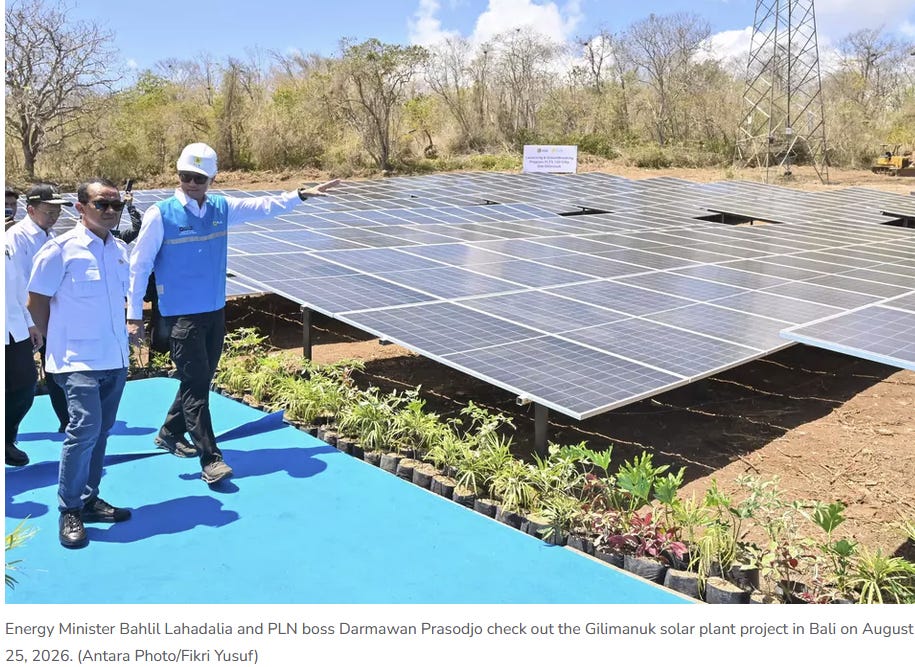
The build-out is planned to occur in multiple phases and across many different models of solar power, including centralized grid-scale, decentralized village-scale, rooftop, and floating solar. Many will also include associated battery storage to build towards 24/7 power! As of now, the plan’s progress so far includes 14 solar projects totaling 5.2 GW in active development across Indonesia, with two active, six under construction, and six seeking investment. Several more are in the works. This is excellent policy-making for the Anthropocene — a new template for epic solar surges!
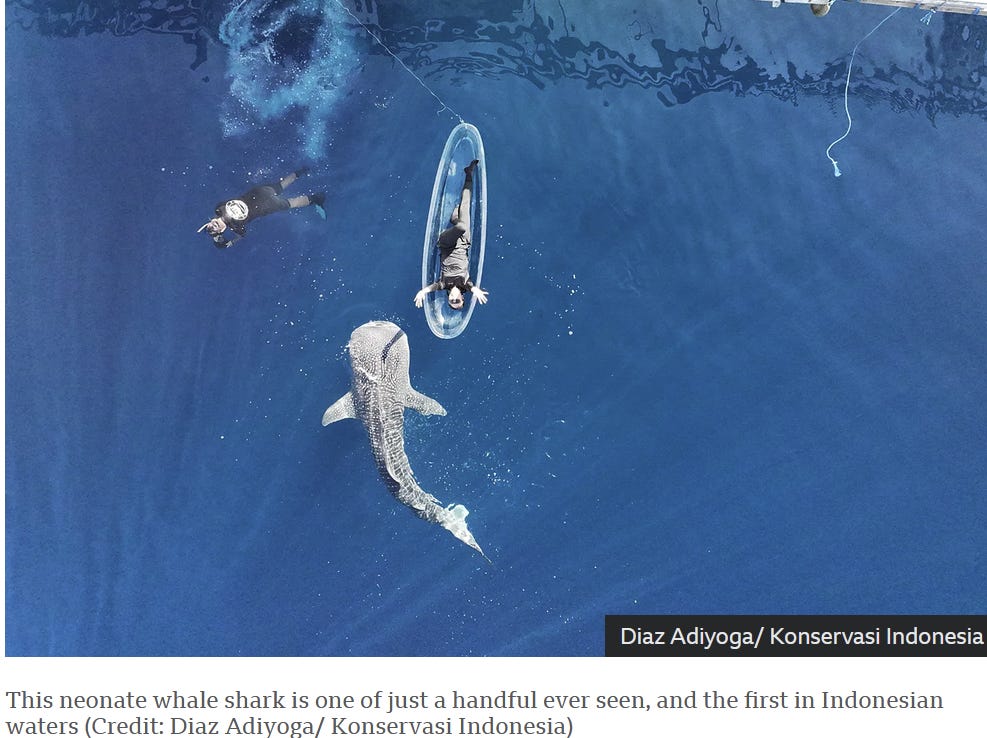
Whale sharks (Rhincodon typus) are massive, endangered, and highly mysterious. Weighing as much as six elephants, they’re by far the world’s largest fish, cold-blooded animal, and largest animal of any kind that isn’t a (mammalian) whale. Human conservationists have studied whale sharks intensively as of late, and endeavored to protect them from threats like overfishing, but despite their wide range across Earth’s tropical seas, no one has yet seen a whale shark mate or give birth.
Now, a small newborn whale shark, only 1.5 meters long, has been spotted in Saleh Bay off the Indonesian island of Sumbawa, strongly suggesting that an unknown whale shark birthing ground is close by. Whale shark ecotourism (a growing field!) is being developed in Saleh Bay to help incentivize community protection, and campaigns to create a marine protected area are in the works. Awesome news!
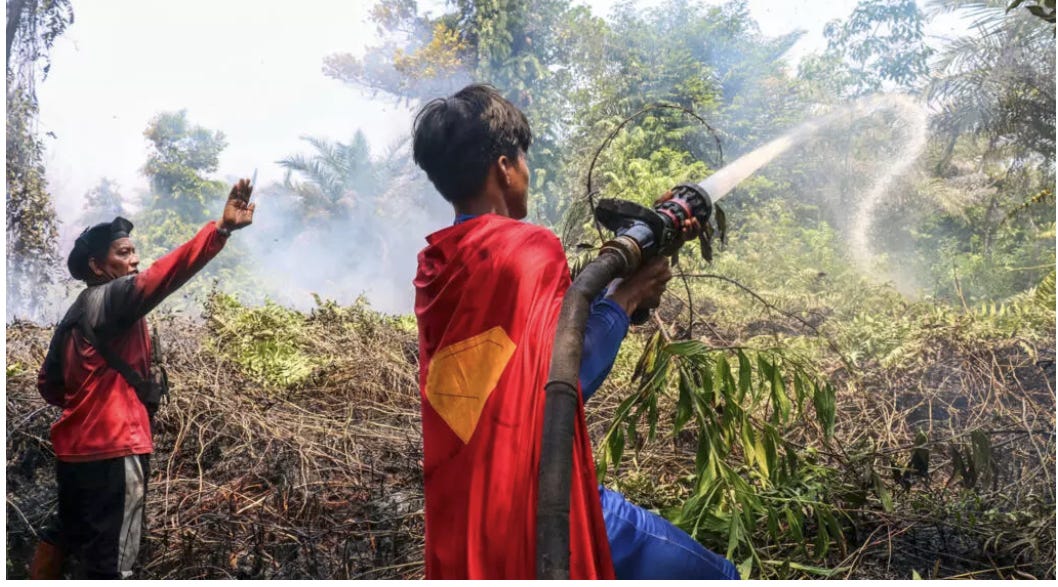
A 17-year-old boy named Rudiyansah has gone viral in Indonesia for his volunteer work fighting severe wildfires in his home province, the Central Kalimantan region of Borneo, while dressed as Superman. His father is a firefighter, and he’s been volunteering since 2023 but only went viral when he wore the costume this year. An innovative way to draw attention to the front-line heroes fighting climate disasters!
United States
Despite the sadistic incompetent gangsters in the White House, people across America keep fighting, striving, innovating, and creating to build a brighter future!

New York City has almost completed the first wave of flood protection efforts launched after surviving Superstorm Sandy in 2012. Manhattan now boasts a cutting-edge East River resilience park, earthen berms, and rolling-track floodgates ready to be deployed in emergencies, beaches have been restored in Queens, and low-lying homes bought out in Staten Island. Mayor Mamdani will soon be overseeing decisions on which additional NYC flood-protection projects to fund with the city’s budget.
In its first-ever agrivoltaics pilot program, New Jersey just approved 16 new solar-plus-farming projects across the state, totaling 52 MW of solar coexisting with established cultivation of soybeans, hay, grains, fruit, vegetables, livestock, and more!
A Utah-style balcony solar bill has passed both houses of the California state legislature! If Governor Newsom signs it into law (it would be really stupid not to), an incredible year for U.S. balcony solar advocacy will culminate with a Golden State win.
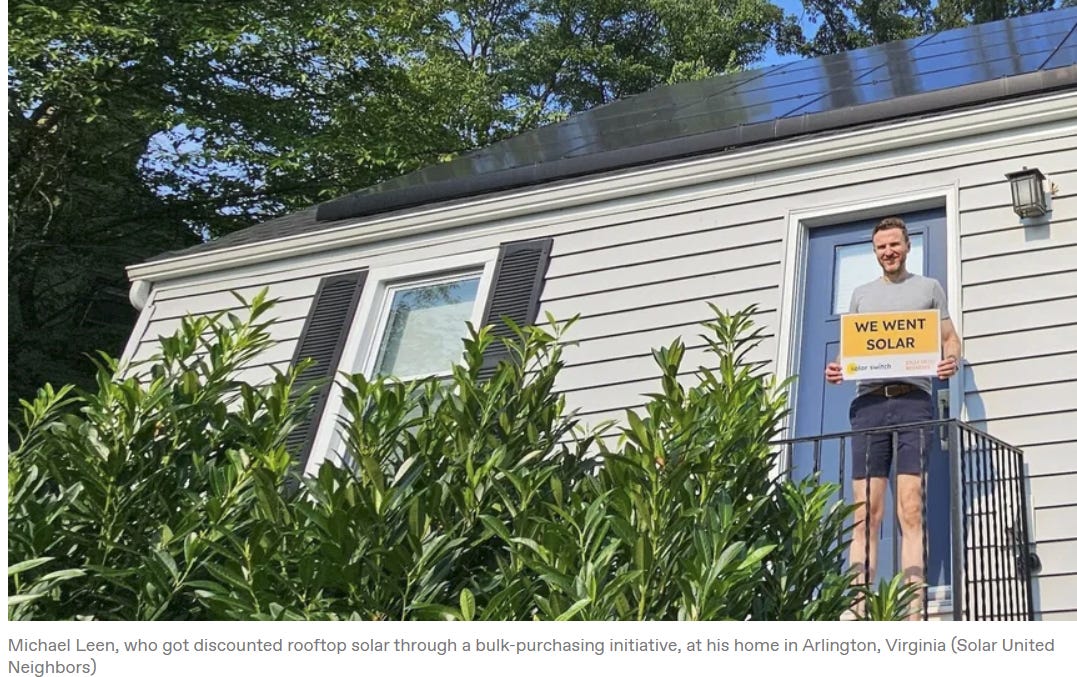
Virginia has launched an awesome new first-in-the-nation electrotech policy: a bulk-buying campaign for rooftop solar, home batteries, EV chargers, and heat pumps! They’ve partnered with nonprofit Solar United Neighbors to coordinate the Switch Together campaign statewide, assembling lists of folks who all want to get rooftop solar soon and matching them with lists of trusted installers who can then buy electrotech in bulk at lower prices thanks to this assured demand. More than 4,300 Virginia residents and businesses have signed up since it began in July, and more than 120 have signed contracts to build. This is a great model, and should be scaled up!
A new 2 GW U.S. solar cell factory has been announced, set to be built in Oklahoma before the end of 2026 and start production by March 2027! U.S. solar keeps growing.

Since July 27, 2026, a rotating cast of local activists — at least one at all times — has been sitting in the branches of a giant centuries-old cottonwood tree in Lochiel, Arizona. They’ve successfully held up construction of this segment of the brutal White House regime’s ecologically and geopolitically destructive border wall in this area for over a month. Spectacular community resistance work — stand strong! And if you’re interested, they’re actively inviting folks to join their nonviolent encampments.
Utility regulators in Maine have approved long-gestating proposals for a new 800 MW wind farm and 1.2 gigawatt transmission line to be built in northern Aroostook County. All six New England states are coordinating to share the costs of this effort, which would substantially clean, stabilize, and reduce costs for the region’s grid!
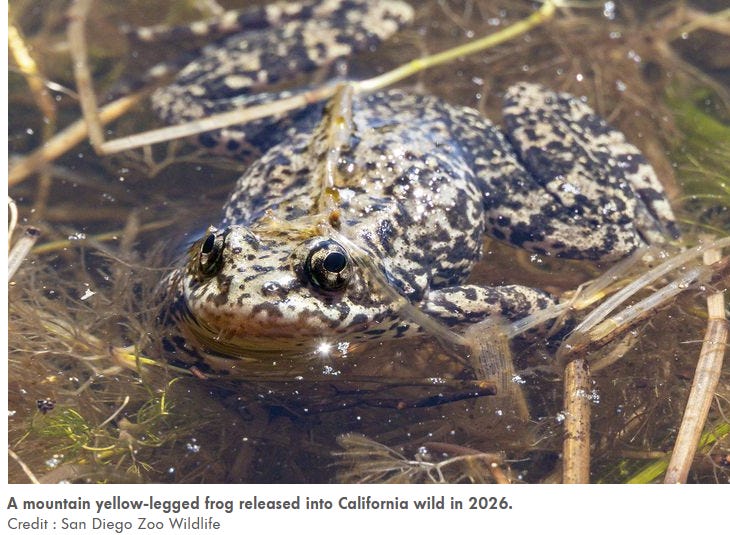
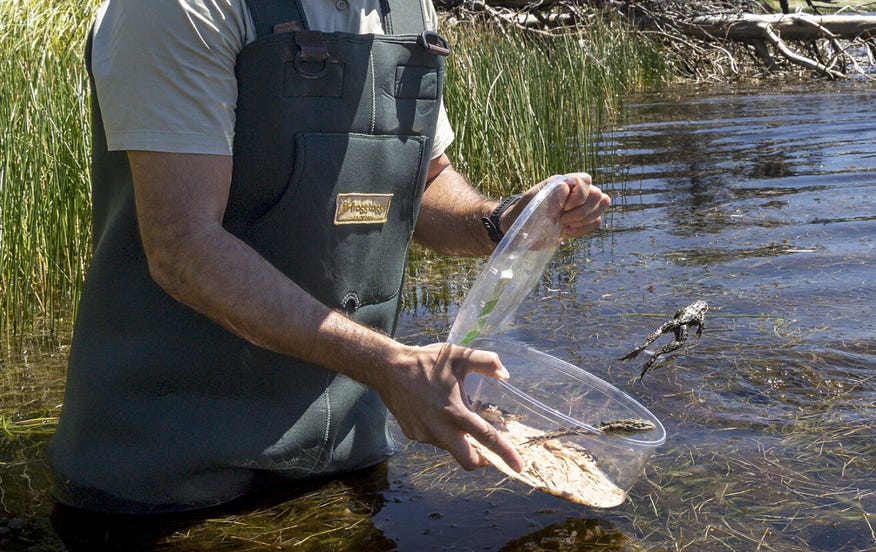
In 2026 so far, San Diego Zoo conservationists have released over 3,000 captive-bred endangered mountain yellow-legged frogs (Rana muscosa), both tadpoles and adults, into the San Bernardino and San Jacinto mountain ranges. Only 200 wild individual frogs of this species were estimated to exist before this year’s releases. Great work!
Great stuff Sam, and I'm particularly intrigued by the Virginia program which sounds like a great idea. I'm getting ready to add a battery to my home solar system and, unfortunately, the economies of scale that we're hearing about haven't hit that part of the industry. Maybe having a working program in place will encourage states like Missouri to jump on the bandwagon.
One thing that worries me about the Africa story: if so much solar is distributed, where does this leave people without access to enough capital? Are they still able to get electricity? How much does it cost?